Yingjie Mu
WORKS
INDEX
ABOUT

A speculative browser-based interface that turns everyday communication
into a system of filtering, scoring, rewriting, vocal control, and emotional censorship.
SINCERITY PROTOCOL
Interaction · Front-End Development
2025 /
Interactive Web Experience / Speculative Interface


ENTER INTERACTIVE EXPERIENCE ↗
Live browser-based project
WEBSITE
& VIDEO
Sincerity Protocol began with a simple observation: everyday communication-emails, apologies, institutional messages-often sounds less like how people actually feel and more like how systems expect them to speak.
The project turns this tension into a fictional language-governance interface. Across six interactive modules, emotional expression is classified, formatted, scored, translated, voiced, and censored, revealing how computational systems can quietly shape what is considered “acceptable” communication.
ABOUT
HTML / CSS / JavaScript / Web Speech API / Figma
TOOLS
Interactive Browser Experience
6 Functional Modules
Speculative Interface System
Responsive Web Prototype
OUTOUT
Concept Development
Visual System Design
Interaction Design
UI & Web Design
Front-End Development
ROLE


Emotion Redaction
REDACT
Remove emotional vocabulary and reduce expression to an archival record.


Voice Governance
VOICE
Extend tone control from writing
into speech.
Tone Converter
TRANSLATE
Rewrite the same message
across different social and power contexts.


Tone Compliance
SCORE
Measure how institutionally acceptable a message sounds.

Apology Machine
FORMAT
Turn personal remorse into a standardized communication template.

Inbox Filter
FILTER
Classify emotional language and rewrite it into institutional tone.
Six modules simulate different ways digital systems reshape human expression-from classification and rewriting to scoring, vocal control, and censorship.
Sincerity is progressively classified, formatted, scored, translated, voiced, and erased.
Language Governance System


The Directory works as an orientation layer, introducing the module system, navigation logic, and project context before users enter the working interface. It separates explanation from interaction, allowing the main console to remain visually dense without overwhelming first-time users.
Navigation and Orientation


The main console acts as a shared interface for all six tools, allowing users to move between different forms of language control without leaving the system.

Users enter what happened, who the apology is for, and a desired social register. The system generates a polished apology, turning sincerity into a repeatable template.
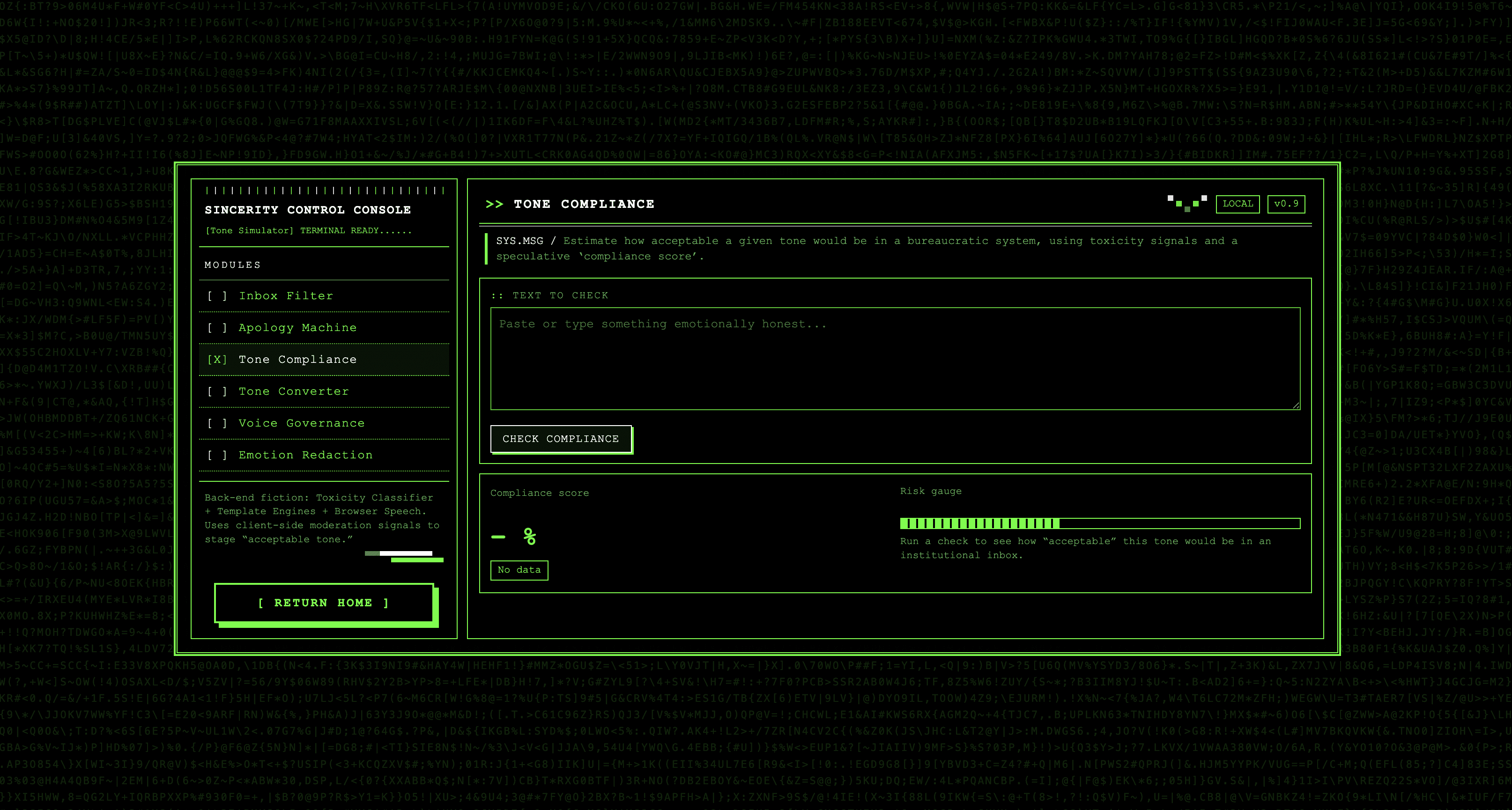
Tone Compliance converts expression into a score, estimating how safe, risky, or institutionally acceptable a message appears.

The same sentence is rewritten across different social registers, revealing how language shifts with audience, authority, and context.

The system moves tone control from text into speech, using browser-based voice presets to alter delivery and perceived authority.
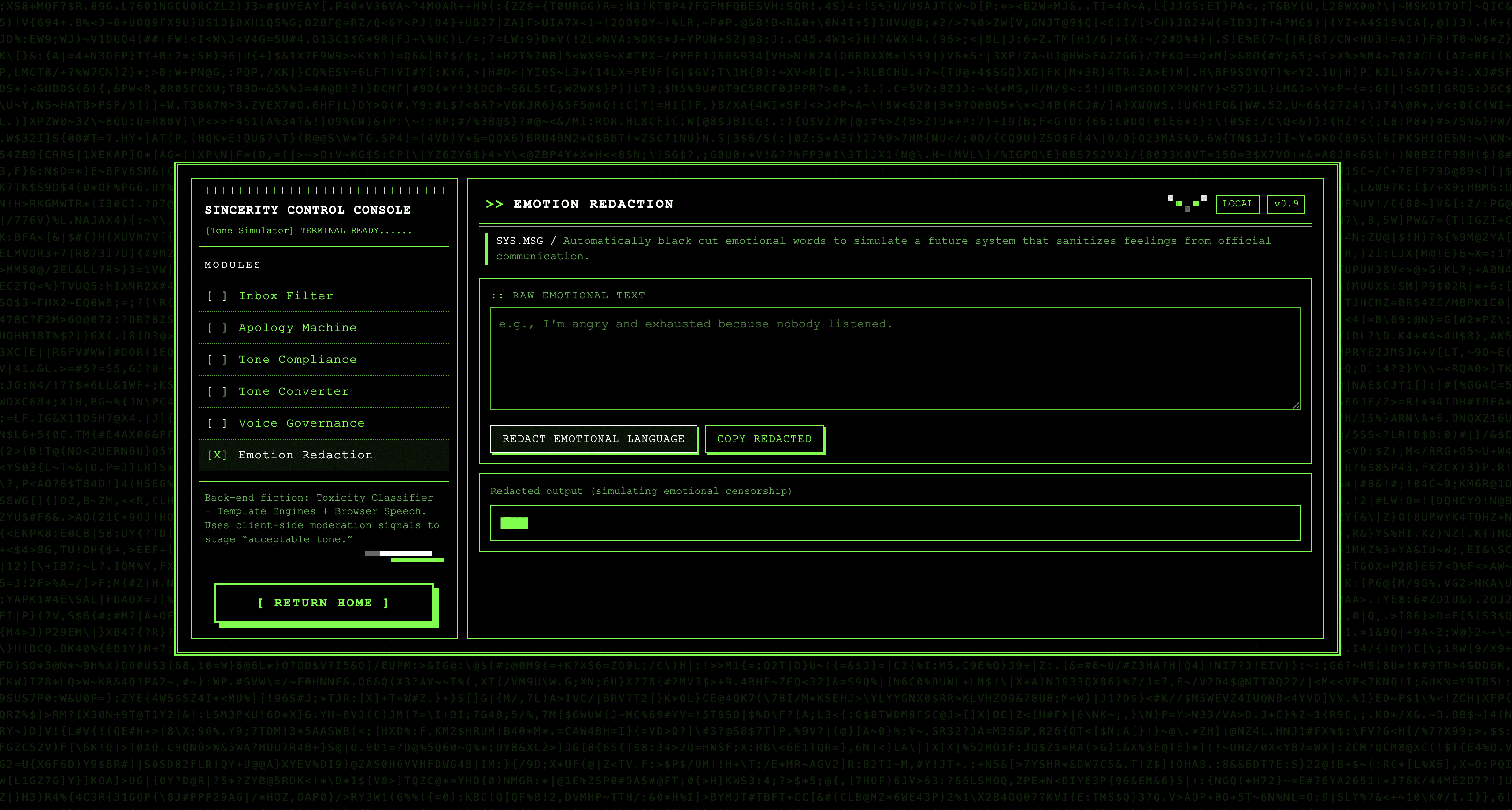
Emotional vocabulary is identified and removed, leaving behind a colder archival record in which feelings are treated as noise or liability.
← 01 / 06 →
Core Interaction
The main console acts as a shared interface for all six tools, allowing users to move between different forms of language control without leaving the system.


Home → Directory → Console


03 / Interface state and navigation
Browser speech synthesis extends the interface from text transformation into voice-based interaction, with preset changes in rate, pitch, and delivery.
JavaScript state logic connects the homepage, directory, and working console into one continuous browser experience.
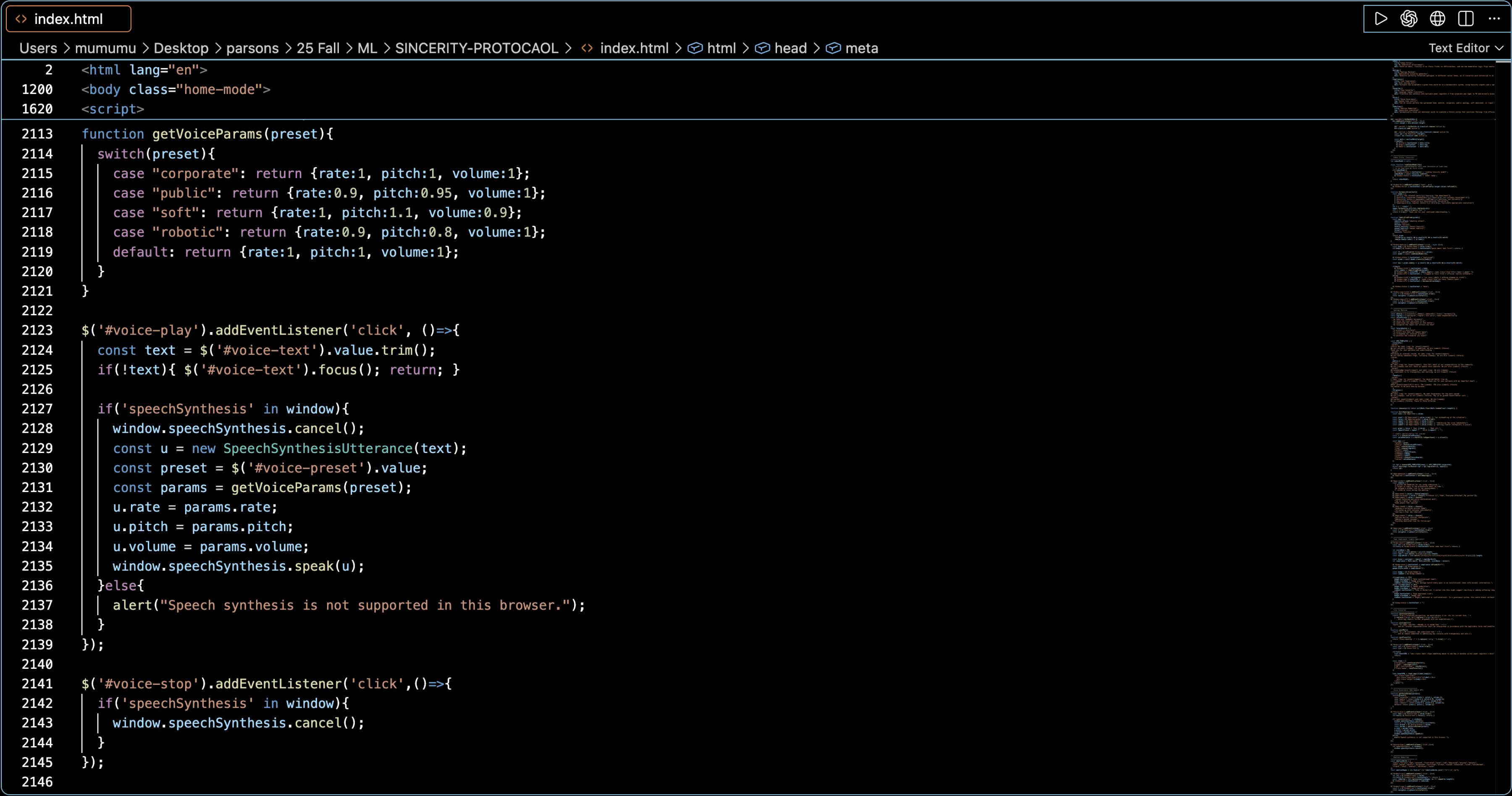

02 / Voice interaction
TensorFlow.js toxicity signals are used to classify user input, then route the text into either a “Toxic Truth” state or an institutional rewrite.


01 / ML-based filtering
Built as a client-side browser experience using HTML, CSS, JavaScript, TensorFlow.js, and the Web Speech API.
Web Development



SINCERITY PROTOCOL //. .*
BACK TO WORKS
PREV WORK